Roll on to the present day. We face the biggest downturn since the the Great Depression which sparked the whole idea of a regulatory state. Income inequality is as high as it was prior to 1929 and social mobility has collapsed. Did this happen overnight? No, since the 1980's neoliberalism and the neoliberalist policies that have been the mainstay of all major political parties (whether it be the Conservatives and New Labour in the U.K. or the Democrats and the Republicans in the U.S.). These policies have lead to a slow stagnation in growth coupled by sporadic financial crises. Many preferred to see these financial crises in terms of the death throes of social democracy and so on the back of this more 'shock therapy' and more restructuring was demanded by bodies such as the World Bank and the IMF. Schumpter used the term creative destruction to refer to a similar aspect of the economy wherein the rise and fall of individual companies leads to creativity and progress. Nowadays, neoliberals use the term to refer to the regeneration that occurs after times of collapse.
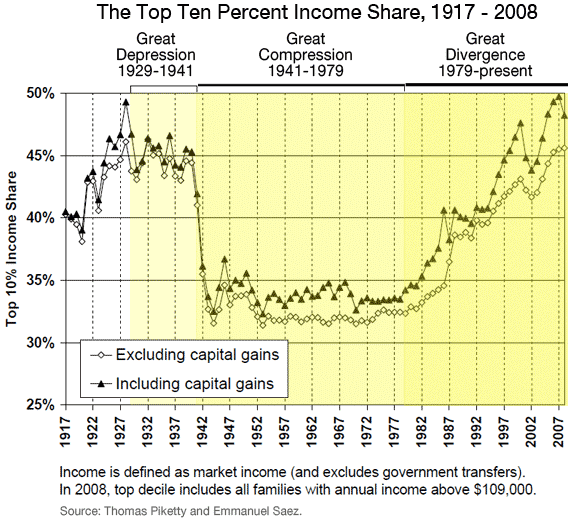 While it has not been expressly articulated (to my knowledge) this idea of creative destruction (collapse followed by rebirth) is an admission of the failure of a stable capitalism using neoliberal (rather than Keynesian) methods. Recessions and financial crashes are now not ust inevitable but necassary for growth. Despite this growth rates have fallen since the hey-day of the 50's and 60's and the decline in social mobility and the restoration of class power (well documented in David Harvey's A Brief History of Neoliberalism) have created new class tensions.
It is these tensions that we see boiling over in the U.S. and most recently in the riots in the U.K. over the past few days.While these individual riots were sparked by the killing of Mark Duggan, this spark was by no means the gunpowder that has been steadily building over the past few decades in the poorest sections of society. These tensions can be tackled in two ways. One is by actually addressing the issues of unemployment, underemployment, massive income inequality and stagnating social mobility that is to give them reform before they give us revolution. This will not come to be anytime soon, too many vested interests and powers-that-be have too much to lose and prevailing dogma tends towards that dreaded word 'austerity'.
Given this it seems inevitable that we will see the authoritarian side of neoliberalism. Instead of addressing problems this will be tackled as a criminal problem with no social roots. We will see increased police presence and increasingly authoritarian practices, not only in the riots today but also into the near future. It is the great irony of neoliberalism that in order to create freedom and wealth it must use authoritarianism to subdue the poor.


