Tuesday, 9 August 2011

"We must give them reform or they will give us revolution."

     These words were uttered by Conservative MP Quintin Hogg in 1943 and essentially summarised prevailing wisdom at the time. The idea of a stable society wherein the worst excesses of capitalism would be tempered by social programs was embraced in the democracies of the day. The state had a role in regulating capitalism and preventing recessions or at least mitigating the worst effects. This state of affairs would last until the late 70's.


    Roll on to the present day. We face the biggest downturn since the the Great Depression which sparked the whole idea of a regulatory state.  Income inequality is as high as it was prior to 1929 and social mobility has collapsed. Did this happen overnight? No, since the 1980's neoliberalism and the neoliberalist policies that have been the mainstay of all major political parties (whether it be the Conservatives and New Labour in the U.K. or the Democrats and the Republicans in the U.S.). These policies have lead to a slow stagnation in growth coupled by sporadic financial crises. Many preferred to see these financial crises in terms of the death throes of social democracy and so on the back of this more 'shock therapy' and more restructuring was demanded by bodies such as the World Bank and the IMF. Schumpter used the term creative destruction to refer to a similar aspect of the economy wherein the rise and fall of individual companies leads to creativity and progress. Nowadays, neoliberals use the term to refer to the regeneration that occurs after times of collapse. 
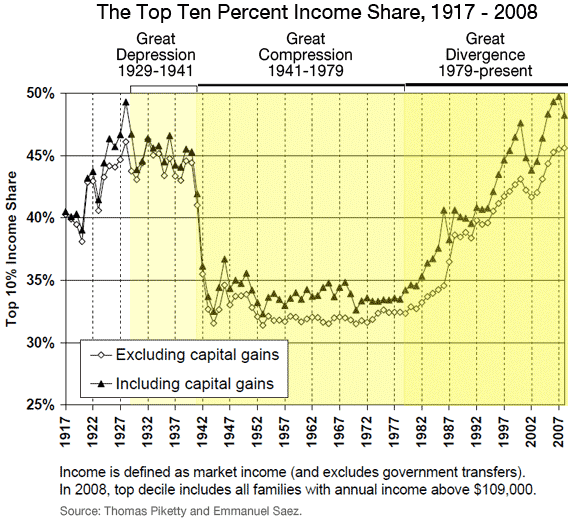

    While it has not been expressly articulated (to my knowledge) this idea of creative destruction (collapse followed by rebirth) is an admission of the failure of a stable capitalism using neoliberal (rather than Keynesian) methods. Recessions and financial crashes are now not ust inevitable but necassary for growth. Despite this growth rates have fallen since the hey-day of the 50's and 60's and the decline in social mobility and the restoration of class power (well documented in David Harvey's A Brief History of Neoliberalism) have created new class tensions.


   It is these tensions that we see boiling over in the U.S. and most recently in the riots in the U.K. over the past few days.While these individual riots were sparked by the killing of Mark Duggan, this spark was by no means the gunpowder that has been steadily building over the past few decades in the poorest sections of society. These tensions can be tackled in two ways. One is by actually addressing the issues of unemployment, underemployment, massive income inequality and stagnating social mobility that is to give them reform before they give us revolution. This will not come to be anytime soon, too many vested interests and powers-that-be have too much to lose and prevailing dogma tends towards that dreaded word 'austerity'. 


   Given this it seems inevitable that we will see the authoritarian side of neoliberalism. Instead of addressing problems this will be tackled as a criminal problem with no social roots. We will see increased police presence and increasingly authoritarian practices, not only in the riots today but also into the near future. It is the great irony of neoliberalism that in order to create freedom and wealth it must use authoritarianism to subdue the poor.

Monday, 1 August 2011

Entrepreneurs, Chance, and the Deterministic Concentration of Wealth

While there are many factors that coalesce to determine an individual's wealth it is more often than not assumed that chance is irrelevant. Any good luck should be cancelled by bad luck, or is unimportant on the aggregate of all individuals. Here is a study which models an economy of complete chance Entrepreneurs, Chance, and the Deterministic Concentration of Wealth.

       Abstract:
"In many economies, wealth is strikingly concentrated. Entrepreneurs–individuals with ownership in for-profit enterprises–comprise a large portion of the wealthiest individuals, and their behavior may help explain patterns in the national distribution of wealth. Entrepreneurs are less diversified and more heavily invested in their own companies than is commonly assumed in economic models. We present an intentionally simplified individual-based model of wealth generation among entrepreneurs to assess the role of chance and determinism in the distribution of wealth. We demonstrate that chance alone, combined with the deterministic effects of compounding returns, can lead to unlimited concentration of wealth, such that the percentage of all wealth owned by a few entrepreneurs eventually approaches 100%. Specifically, concentration of wealth results when the rate of return on investment varies by entrepreneur and by time. This result is robust to inclusion of realities such as differing skill among entrepreneurs. The most likely overall growth rate of the economy decreases as businesses become less diverse, suggesting that high concentrations of wealth may adversely affect a country's economic growth. We show that a tax on large inherited fortunes, applied to a small portion of the most fortunate in the population, can efficiently arrest the concentration of wealth at intermediate levels."

        While there are obviously more factors to the economy than chance (I would particularly include the effects of income inequalities, poverty and low social mobility on motivation etc.) this study demonstrates the compounding effect of wealth even in the absence of real skill. So while nowhere near a real model of an economy it does serve a useless purpose. I am interested in your thoughts blogosphere!

Sunday, 31 July 2011

Cold War Paranoia

   In the 1970's Team B was set up, after being heavily pushed for by a younger Donald Rumsfeld. It served as an ideological weapon with which the Neoconservatives would drum fear into the American people and so pave way for their election (in the form of Ronald Reagan with his missile gap).
    One of the most disgraceful pieces of distortion was with regard to anti-submarine warfare. The CIA believed that the Soviets were not putting large amounts of resources into a submarine detection system. Team B in an incredible leap of paranoid logic took the same facts and concluded the following - the fact that the evidence was lacking was evidence in itself!
   The reasoning? Clearly if there were no clear signs of a submarine detection system it meant that the Soviets had developed a system completely indetectable to the U.S.! This reminds me of a wonderful scene in the fantastic book A Scanner Darkly by Philip K. Dick when the main character and his friends return home, paranoid about whether or not their home was broken into in their absence.

    "When they rolled to a stop in the driveway, parked , and walked warily toward the front door, they found Barris's note and the door unlocked, but when they cautiously opened the door everything appeared as it had been when they left.
     Barris's suspicions surfaced instantly. "Ah," he murmered, entering. He swiftly reached to the top of the bookshelf by the door and brought down his .22 pistol, which he gripped as the other men moved about. The animals approached them as usual, clamoring to be fed.
    "Well, Barris," Luckman said, "I can see you're right. There definitely was someone here, because you see—you see, too, don't you, Bob?—the scrupulous covering-over of all the signs they would otherwise left testifies to their—""

    In precisely the same fashion as the paranoid drug addicts above, for the Neoconservative, a lack of evidence is evidence of a still greater crime. One has to wonder how much this influenced Rumsfeld and Bush when they considered WMDs in Iraq. And as they sought to instil fear in the American people as Reagan did with his missile gap.

Saturday, 9 July 2011

Flat Earth News

    The recent scandals regarding the News of The World reminded me of a book Flat Earth News by Nick Davies. The book concerns systematic problems in the U.K. press by drawing on the author's personal experiences in the industry as well as various scandals. The book does contain some interesting facts about the rise of Murdoch and makes for a very good read.
  All this got me to thinking about self-censorship and systematic press failures, as well as the problems associated with the centralisation of ownership. I am considering buying Chomsky's Manufacturing Consent or a similar book dealing with similar themes. Well, that's it, a poor book recommendation.......

Thursday, 7 July 2011

Conservative Denialism

     We often see, from the right (particularly in the U.S. and U.K.), the notion of personal responsibility. The remedy to any social problem such as unemployment, crime, teenage pregnancies etc. is supposedly the individual in question making the right choice and to stop making the choices that lead to this position. This approach has meet with major successes in both the U.K. and the U.S. mainly in religious communities. This post will examine the problems with this one size fits all tonic.
       It really boils down to a question of denialism. It is a well-observed fact that bringing people up in particular environments makes it statistically likely that they will exhibit certain behaviours. If one continually places people in position A and is faced with these people making choice X then it becomes the height of denial to insist that should these individuals change their behaviours the problem wouldn't exist. The conservative in this respect is similar to a scientist putting water in an environment below 0 degrees Celsius and then rebuking the molecules for forming ice. If a certain environment leads to certain behaviours then it is sheer denial to insist that these behaviours are not somewhat determined by said environment.
    The conservative position is perfectly sound with impeccable logic, if drug addicts chose not to use drugs they would be no longer drug addicts. Despite the soundness of this reasoning it is evidently moronic. While fully accepting the role of choice and not attempting to diminish responsibility we must ask what factors influence choices?
    If we can answer this question, i.e. what factors influence choices? Then we are most of the way there. If we can show that prevalent levels of income inequality lead to a greater homicide rate (mentioned in my previous post) then we cannot simply sit back and demand that these people choose differently. This approach is naught but denial at can be incredibly dangerous. We are faced with an ultimatum, either we do not try to solve the problem and deal with the increasing crime through prisons (the current approach) or we attempt to solve the problem. It cannot do to claim the problem does not exist.

Wednesday, 6 July 2011

Libertarianism and the Maximisation of Liberty

       In a similar vein to my previous post on Jevon's paradox I now ask about another seeming paradox. Libertarians often propose an 'objectively' derived system based on the maximisation of liberty. Leaving aside my initial objections with regard to the value judgements in play here, let's examine their claim.
     At first glance, the system libertarians propose does indeed seem to maximise liberty however as we know from Jevon, first glances may be deceptive. It very well may be that the libertarian system is indeed the one that maximises liberty but does follow 'objectively' (even allowing for the nonsenses inherent in that term)? I think not. The libertarian reasoning here is naive.
    To illustrate the point I offer an example. Suppose we wished to reduce alcohol consumption, the most logical method would be to ban alcohol consumption, no? Of course anyone with half an understanding of history or how people work would know that this is perhaps the worst way of going about it. The law of unintended consequences is at work here. Prohibition leads to an explosion of organised crime, murder and doesn't stop alcohol consumption.
   Given that the naive approach does not necassarily work then can we just assume that the naive libertarian approach works? I argue not. It may well be that libertarianism is the system that maximises liberty but the reasoning employed is horribly wrong. To offer a single example I point to how increasing income inequality results in increasing homicide.


   These considerations do enter into libertarianism but only lightly. For example, murder is curtailed as the liberty to murder reduces net liberty (for those killed mainly). Do other considerations apply? Does the curtailment of liberty entailed by taxation (and its expenditure on certain items) lead to a net increase or decrease of liberty if this tax is used to prevent muder and the like? These are questions libertarians must answer if they are to escape from their current naive position, and while it may be that they find in the end that their initial position was right then all the better for them. Their first hurdle will be to find a method to compare degrees of liberty, I very much feel this is where they will fall.

Monday, 4 July 2011

Income Inequality and the Great Recession

It has always been a contention of mine that massive income inequalities and the resulting wealth polarisation leads to an excess of available capital in relation to the available investment opportunities leading to stagnation and collapse. I recently stumbled across a report: Income Inequality and the Great Recession by the U.S. Congress Joint Economic Committee which seems to roughly corroborate my views. I recommend reading it, but I'll put out a few choice snippets:

 "Income inequality may be part of the root cause of the Great Recession. Stagnant
incomes for all but the wealthiest Americans meant an increased demand for credit,
fueling the growth of an unsustainable credit bubble. Bank deregulation allowed
financial institutions to create new exotic products in which the ever‐richer rich could
invest. The result was a bubble‐based economy that came crashing down in late 2007"

"Income inequality may be part of the root cause of the Great Recession. Stagnant
incomes for all but the wealthiest Americans meant an increased demand for credit,
fueling the growth of an unsustainable credit bubble. Bank deregulation allowed
financial institutions to create new exotic products in which the ever‐richer rich could
invest. The result was a bubble‐based economy that came crashing down in late 2007"

The graphs alone are worth viewing. Over and out.